Kundli Milan for Marriage: How 36 Gunas Are Matched and What the Score Misses
By Astro Sandeep, Vedic astrologer and Lal Kitab expert with 21+ years of experience
Key points at a glance
- Kundli milan in North India uses the Ashtakoot system, which scores a couple out of 36 gunas across eight kootas, from Varna (1 point) to Nadi (8 points).
- Tradition treats 18 out of 36 as the minimum for a match to be considered, but the score alone never decides whether a marriage will work.
- Nadi and Bhakoot carry 15 of the 36 points, so a zero in either pulls the score down sharply, and both have classical cancellation rules.
- A full match also checks Manglik dosha, the 7th house and its lord, the Navamsa (D9) chart and the dasha each person is running.
- Kundli milan is only as accurate as the birth times used; a 15-minute error can change the nakshatra pada and the result.
A family from Ludhiana called me last winter, worried. The rishta (marriage proposal) had gone well. The two families got along, the boy and girl liked each other, and the roka was being planned. Then a cousin ran both names through a free app and the screen said 14 out of 36. Everyone went quiet. This happens in my practice every single wedding season, and it is why I want to explain what kundli milan actually measures, where the 36-guna score comes from and what it leaves out. If you have not matched your charts yet, you can start with our free kundli matching tool and then read the score with the context below.
Book a marriage astrology and kundli matching consultation with Astro Sandeep
What is kundli milan?
Kundli milan is the Vedic practice of comparing the birth charts (kundlis) of a boy and girl before marriage. In North India it uses the Ashtakoot method: eight factors (kootas) based mainly on the Moon's sign and nakshatra, scored out of 36 gunas, followed by checks on Manglik dosha, the 7th house and planetary periods.
How the 36 gunas are scored in Ashtakoot milan
The 36 gunas come from eight kootas, each worth a fixed number of points, and almost all of them are calculated from the Moon sign (rashi) and birth star (nakshatra) of each person. That is why two people born on the same day, a few hours apart, can get different scores.
| Koota | Points | What it checks |
|---|---|---|
| Varna | 1 | Spiritual and ego compatibility, from the varna of each Moon sign |
| Vashya | 2 | Mutual attraction and who tends to lead in the relationship |
| Tara (Dina) | 3 | Birth-star compatibility, linked to wellbeing and fortune after marriage |
| Yoni | 4 | Physical and instinctive compatibility, from the animal symbol of each nakshatra |
| Graha Maitri | 5 | Friendship between the lords of the two Moon signs; mental wavelength |
| Gana | 6 | Temperament: Deva, Manushya or Rakshasa nature |
| Bhakoot | 7 | Relative position of the two Moon signs; family welfare, finances and growth |
| Nadi | 8 | Adi, Madhya or Antya nadi; health and progeny in traditional texts |
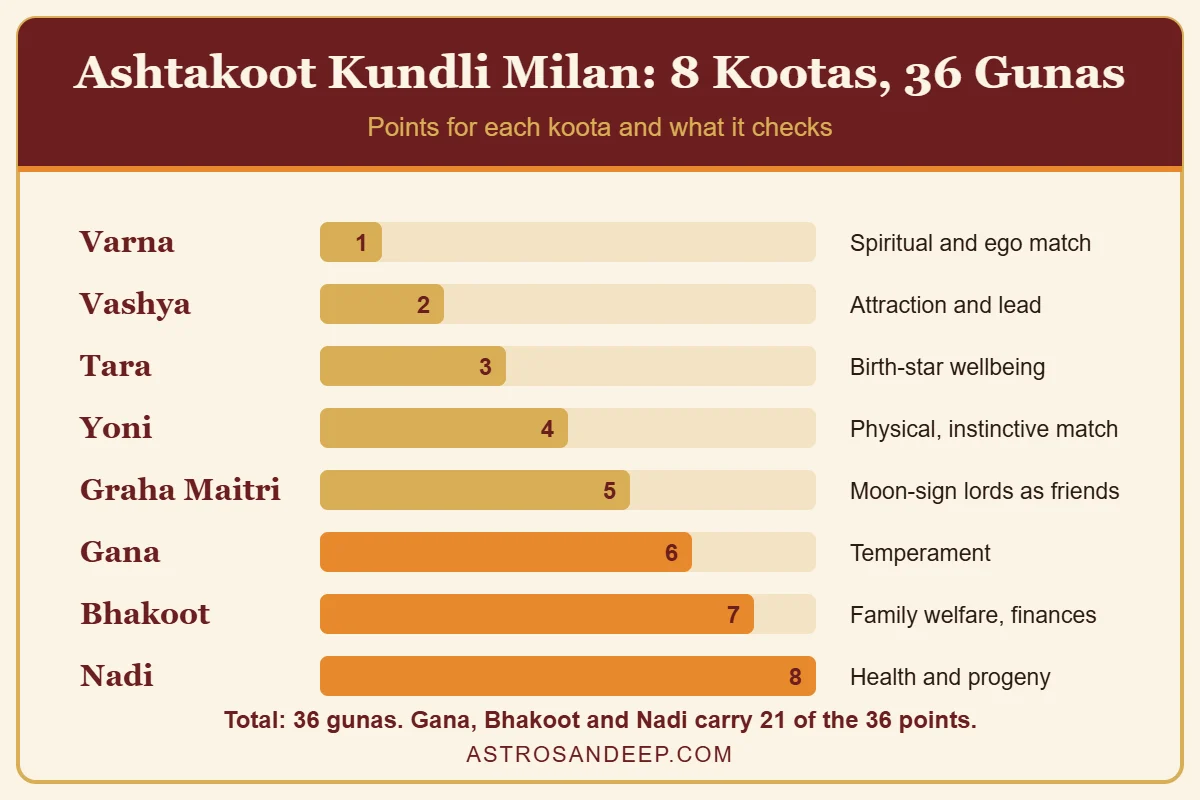
Notice the weighting. The last three kootas (Gana, Bhakoot and Nadi) carry 21 of the 36 points. A couple can be well matched on six kootas and still score low because Bhakoot or Nadi came out at zero. That is exactly what had happened to the Ludhiana family.
South Indian families often use a different system, the Dashakoot or ten poruthams, which weighs Rajju and Vedha heavily. If one family follows the North Indian method and the other the South Indian one, expect two different answers from the same charts.
What does a kundli milan score mean?
The score is a first filter, not a verdict: below 18 tradition advises caution, 18 to 24 is workable, 25 to 32 is good, and 33 or more is rare and very good on paper.
| Gunas matched | Traditional reading | What I do next |
|---|---|---|
| 0 to 17 | Not recommended without further checks | Look for Nadi or Bhakoot cancellation, then judge the 7th house of both charts |
| 18 to 24 | Average, acceptable | Check Manglik status, D9 chart and the dashas due in the first years of marriage |
| 25 to 32 | Good match | Still check Nadi, Bhakoot and the 7th lord; a high score can hide one serious issue |
| 33 to 36 | Excellent on paper | Confirm birth times, because very high scores sometimes come from a wrong nakshatra |
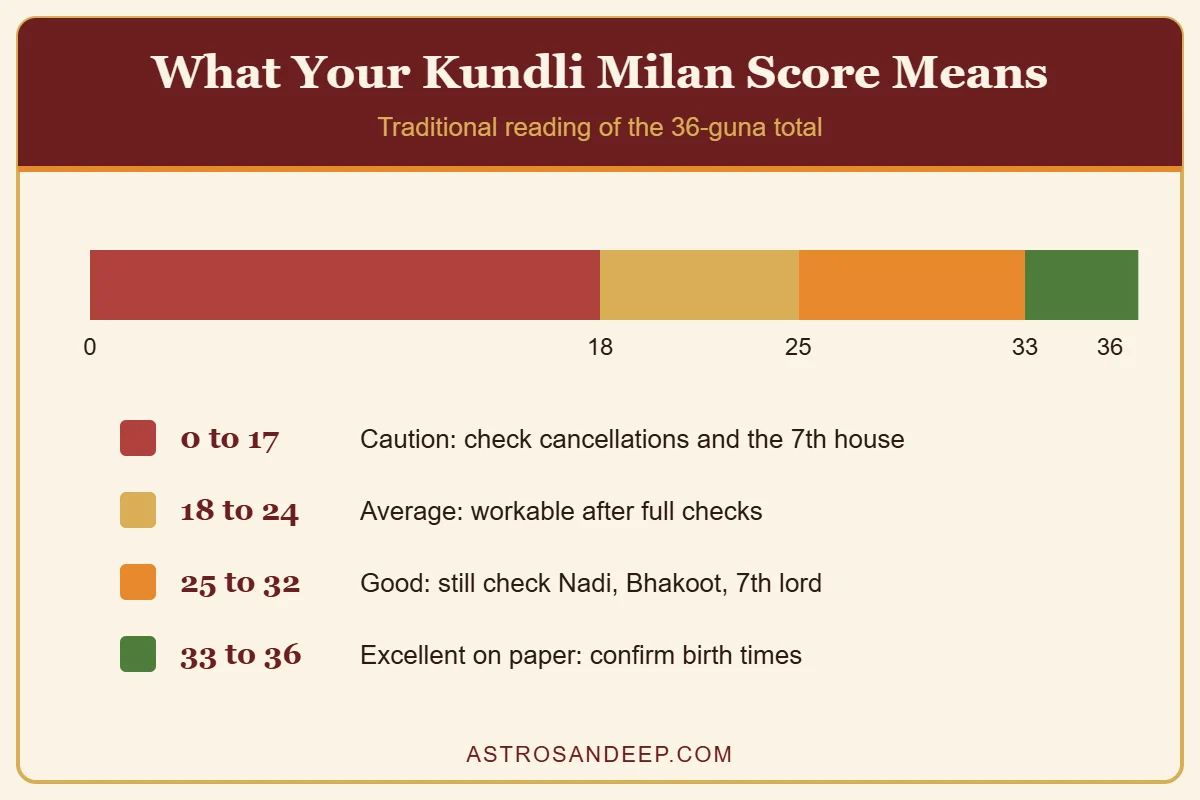
Many sites say "never marry below 18". I disagree, and here is why. In 21 years I have seen many couples with 16 or 17 gunas whose Bhakoot dosha was cancelled by friendly Moon-sign lords and whose 7th houses were strong. Their marriages were steady. I have also seen 30-guna matches struggle because one partner had Saturn and Rahu afflicting the 7th lord and a difficult dasha starting a year after the wedding.
How I read a kundli milan, step by step
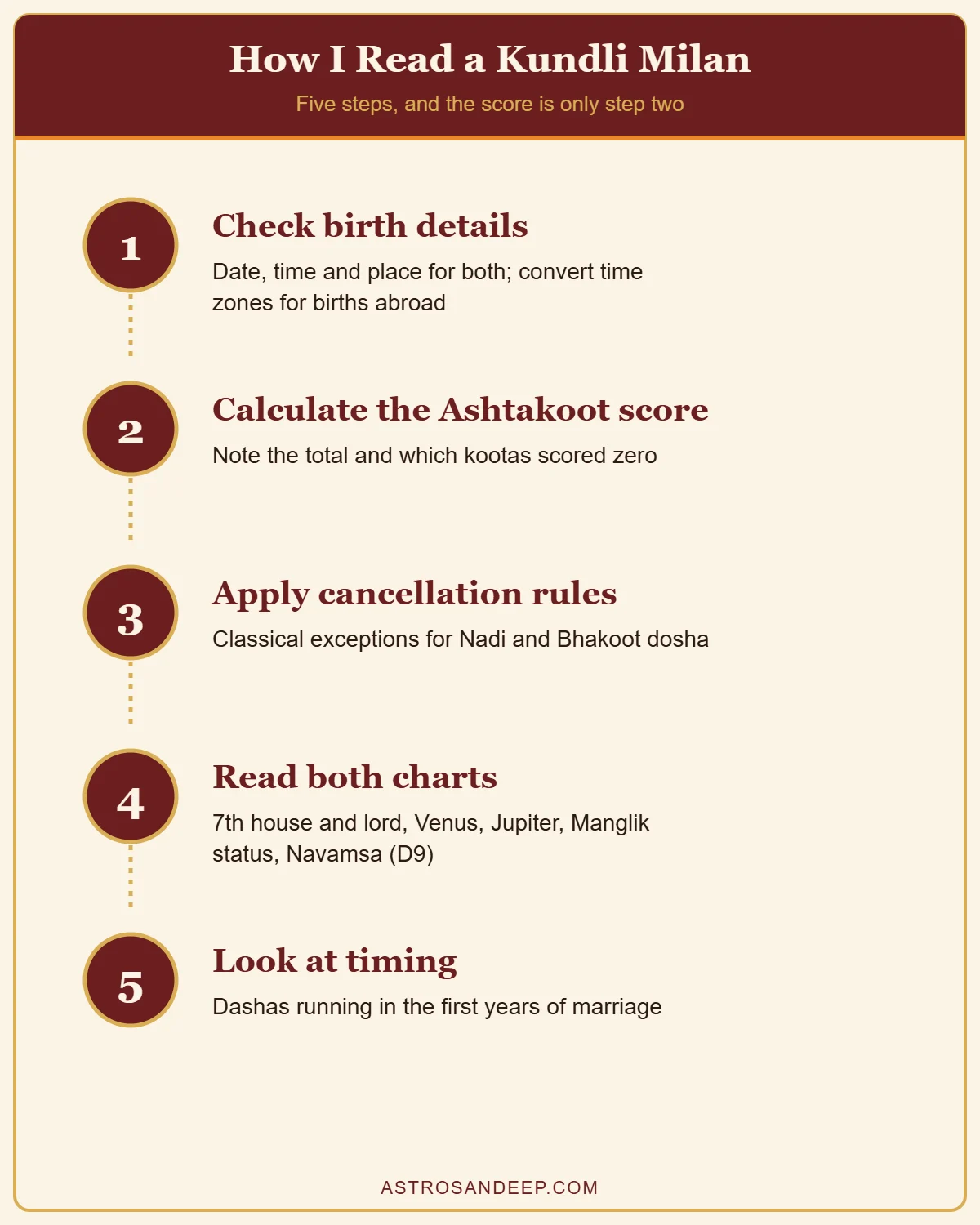
I read a match in five steps, and the 36-guna score is only the second one.
- Check the birth details. I confirm date, time and place for both, and convert time zones for anyone born abroad. A wrong birth time can shift the Moon's nakshatra pada and change Nadi or Tara.
- Calculate the Ashtakoot score. I note the total, but more importantly which kootas scored zero.
- Apply cancellation rules. Nadi and Bhakoot dosha have classical exceptions. I check whether any apply before treating a low score as a problem.
- Read both charts on their own. The 7th house, its lord, Venus for the boy and Jupiter for the girl, Manglik status from the Lagna and Moon, and the Navamsa (D9). Brihat Parashara Hora Shastra gives the 7th house as the house of the spouse; the D9 shows whether that promise holds.
- Look at timing. Which Vimshottari dasha will each person be running in the first five to seven years of marriage? Two difficult periods starting together deserve attention, whatever the score says.
If you want to understand how the individual chart is read before matching, my guide on full kundli analysis goes through the houses and planets one by one.
Nadi dosha and Bhakoot dosha: the two big deductions
Nadi dosha and Bhakoot dosha matter most because together they can take away 15 points, but both are cancelled more often than families realise.
Nadi dosha
Nadi dosha arises when both people share the same nadi (Adi, Madhya or Antya). The match gets 0 out of 8 for Nadi. Traditional texts link it to health and children. Commonly cited exceptions include both people having the same Moon sign but different nakshatras, or the same nakshatra but different Moon signs or padas. I check each exception against the actual degrees, not just the nakshatra name.
Bhakoot dosha
Bhakoot dosha comes from the relative position of the two Moon signs: 6/8, 2/12 or 5/9 from each other. It scores 0 out of 7. It is generally considered cancelled when the lords of the two Moon signs are the same planet or natural friends, for example Moon signs ruled by Mars on both sides.
Talk to me about Lal Kitab remedies after a kundli milan
What the 36-guna score misses
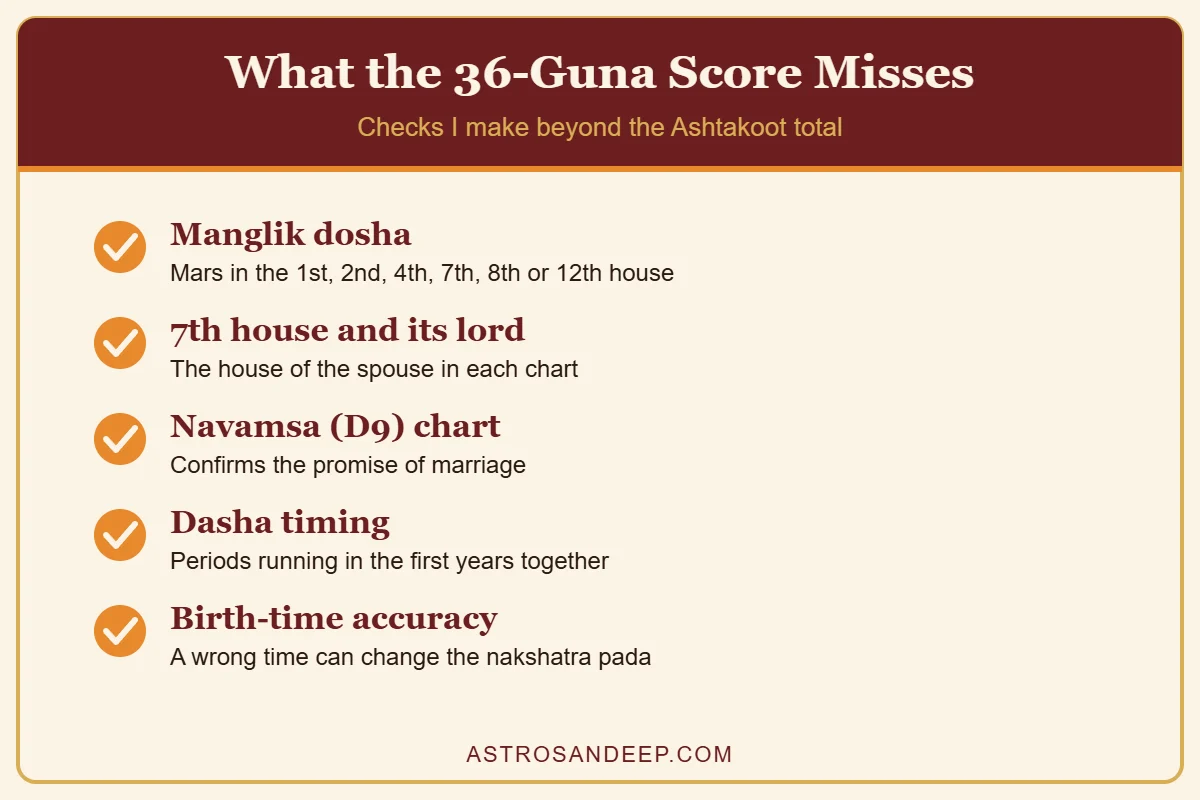
The guna score looks almost only at the Moon, so it cannot see the 7th house, Manglik dosha, the Navamsa or timing, and these often matter more.
- Manglik dosha: Mars in the 1st, 2nd, 4th, 7th, 8th or 12th house. It is checked separately and has its own cancellations.
- The 7th house and its lord: a 7th lord placed in the 6th, 8th or 12th, or afflicted by Saturn and Rahu, says more about married life than Yoni or Varna ever will.
- Navamsa (D9): the chart of marriage. A good D9 on both sides can carry an average guna score.
- Dasha timing: who is entering a Saturn or Rahu period in the first years of marriage.
- Lal Kitab view: Lal Kitab has no 36-guna system at all. In Lal Kitab I compare which houses Venus, Mercury and the Moon occupy in both charts and look for signs of rin (inherited karmic debts) that affect the household. I keep this separate from the Vedic score so the two methods are not mixed.
One honest limitation: kundli milan cannot measure character, effort or how two families handle disagreement. I tell families this plainly. The charts show tendencies and timing. The marriage is made by the two people.
Myths and facts about kundli matching
| Myth | Fact |
|---|---|
| Below 18 gunas, the marriage will fail. | 18 is a traditional threshold. Cancellations and a strong 7th house can make a lower score workable. |
| 36 out of 36 means a perfect marriage. | A full score only means the Moon placements agree. Manglik dosha, the 7th lord and dashas can still be difficult. |
| An online app gives the same result as an astrologer. | Apps calculate Ashtakoot correctly but rarely apply cancellations or read the D9 and dashas. |
| Nadi dosha always means health problems or no children. | Nadi dosha has recognised exceptions, and no chart decides health. See a doctor for medical concerns. |
| Remedies can turn a bad match into a good one. | Remedies are traditional acts of faith. They support effort and understanding; they cannot change the charts. |
Safe remedies when a match shows a dosha
When a match is otherwise sound and one koota scores zero, families often choose simple traditional remedies, always after a personal chart check and never as a guarantee.
Vedic remedies
- For Nadi dosha, Mahamrityunjaya mantra jaap by the couple or family, and a donation of grain or clothes to those in need.
- For Bhakoot dosha, worship of the lords of both Moon signs on their days, for example Monday for the Moon or Thursday for Jupiter.
- Choosing a strong vivah muhurat (wedding time) that supports the 7th house.
Lal Kitab remedies
- Lal Kitab upay are chosen house by house from the actual chart, so I do not list one remedy for everyone. Typical upay are small, low-cost actions done for 40 or 43 days.
- Any Lal Kitab remedy should be done by the person whose chart needs it, not by a relative on their behalf.
Gemstones are not a remedy for a low guna score. I only suggest one after reading the full chart.
An illustrative example: 14 gunas, and what the full reading showed
This example is illustrative and does not describe a real client.
Take a girl from Ludhiana and a boy whose family lives in Brampton. Their match shows 14 out of 36. Bhakoot is zero because their Moon signs are 6/8 from each other, and Gana scores low. On paper, families would walk away.
On a full reading, the two Moon-sign lords are natural friends, so the Bhakoot dosha is cancelled by the classical rule. That takes the working picture well above the bare score. Neither chart is Manglik. The girl's 7th lord Jupiter sits in a kendra, and the boy's Venus is strong in the D9. The only caution is timing: the boy enters Rahu antardasha about two years after the proposed wedding. I would advise the family that the match is workable, suggest a muhurat that avoids that stretch for the wedding itself, and remind them that patience during that period matters more than any upay.
Kundli milan for families in Chandigarh, Punjab and abroad
I do kundli milan in person at my office in Mohali and online for families anywhere, and both give the same depth of reading.
Families from Chandigarh, Mohali, Panchkula, Zirakpur and Kharar usually visit the office with both kundlis. Many from Ludhiana, Patiala, Ambala and Delhi NCR prefer a video or phone session. For NRI families in Brampton, Surrey, Toronto, the USA, Australia and New Zealand, the main thing is the birth time: a child born in Toronto at 9:10 PM local time must be calculated for Toronto's time zone and coordinates, not converted to IST first. I handle that conversion myself. If you would like to know more about the office and how sessions work, read about my practice as an astrologer in the Chandigarh tricity.
If the question in your family is less about matching and more about when the wedding will happen at all, my article on shaadi kab hogi: timing marriage from the kundli covers the dashas and transits that bring marriage. For a love match where the families are still hesitant, my love and relationship astrology sessions look at both charts with that situation in mind.
Frequently asked questions
How many gunas should match for marriage?
Tradition asks for at least 18 out of 36 gunas. That number is a guide, not a rule. I always check which kootas scored zero, whether Nadi or Bhakoot dosha is cancelled, and how strong the 7th house is in both charts before I advise a family on a match below or around 18.
Is kundli milan possible without an exact birth time?
A basic score is possible, but it is less reliable. The Ashtakoot score depends on the Moon's nakshatra, which changes roughly every day, so a date gives a rough answer. Manglik dosha, the 7th house and the D9 need an accurate birth time. If the time is unknown, I can work with life events to estimate it.
Can kundli milan be done by name only?
Name-based matching exists, but I do not rely on it. It guesses the nakshatra from the first letter of the name, which is often wrong, especially for names chosen outside the naming tradition. Use birth details whenever you have them; they are the basis of every reliable kundli milan.
What happens if Nadi dosha is present?
The match scores 0 out of 8 for Nadi, but that is not the end of it. First check the classical exceptions, such as the same Moon sign with different nakshatras. If the dosha stands, families often choose Mahamrityunjaya jaap as a traditional remedy, and any health concern should always go to a doctor.
Is a 30-guna match always safe?
No. A high score means the Moon placements agree, nothing more. I have seen 30-guna matches where one partner was strongly Manglik or had the 7th lord badly placed. Read the full charts and the dashas for the first years of marriage before you treat a high score as final.
Can I do kundli milan online with Astro Sandeep from Canada or the USA?
Yes. Online sessions work exactly like office sessions. Share the date, time and place of birth for both people, and I calculate each chart for the actual place of birth and its time zone. Many NRI families in Canada, the USA and Australia consult me this way before a roka or engagement.
Does Lal Kitab use the 36-guna system?
No. Lal Kitab has its own method and does not score gunas. It compares the house placements in both charts and looks for karmic debts that affect the household. I treat the Vedic and Lal Kitab readings as two separate views and tell families which point comes from which system.
Before you fix the rishta
Kundli milan is a sensible first step, and the 36-guna score is a useful starting number. Read it with the cancellations, the 7th house, the D9 and the dashas, and you get an answer you can trust far more than an app screen. If you are close to a roka or engagement, book a consultation with Astro Sandeep with both sets of birth details ready. You can also make your free kundli first to check the birth data.
Disclaimer: Astrology, Lal Kitab, numerology and tarot offer guidance based on traditional principles. They are not a substitute for medical, legal, financial, immigration or psychological advice, and no astrologer can guarantee an outcome.