
Lal Kitab Remedies: The Rules, the 1952 Text and Upay That Are Safe to Try
By Astro Sandeep, Vedic astrologer and Lal Kitab expert with 21+ years of experience
Key points at a glance
- Lal Kitab is a Punjab-born system of astrology and remedies, written in Urdu and Hindi in five volumes between 1939 and 1952, credited to Pandit Roop Chand Joshi.
- The 1952 edition, Ilm-e-Samudrik ki Buniyad par ki Lal Kitab, is the longest volume and the one most practitioners treat as final.
- Lal Kitab remedies are small, low-cost daily actions (feeding, donating, keeping or flowing an object), not costly pujas or gemstones.
- The classic rules: one remedy at a time, done in daylight, usually for 40 or 43 days without a break.
- A remedy is chosen from your own chart. The same upay can help one person and do nothing, or create trouble, for another.
- Remedies are acts of faith and discipline. They cannot guarantee an outcome or replace effort, a doctor or a lawyer.
A man from Ludhiana once came to my Mohali office with a printed list of fourteen totke he had copied from YouTube. He was doing all of them together. Coins in the river on Saturday, a copper coin under the pillow, feeding crows, a silver square in the wallet. His business problem had not changed in six months, and his wife was tired of the routine. The first thing I did was open his kundli, the way I explain in my guide to how a kundli analysis is done, and then I asked him to stop eleven of those fourteen. Lal Kitab remedies work on rules. Break the rules and you are only collecting habits. This guide explains the rules, the text they come from, and the upay I consider safe for most families to try.
Book a Lal Kitab consultation and get remedies chosen from your own chart
What are Lal Kitab remedies?
Lal Kitab remedies (Lal Kitab upay or totke) are simple, inexpensive actions prescribed in the Lal Kitab texts of 1939–1952 to reduce the troubles shown by a planet in a particular house. They use everyday things such as water, jaggery, copper, silver, lentils or service to family members, and each one is tied to a specific planet and house in your chart.
Where Lal Kitab comes from: the five volumes and the 1952 text
Lal Kitab is a set of five books written in Punjab between 1939 and 1952, attributed to Pandit Roop Chand Joshi of Pharwala village in Jalandhar district. The red cover gave it the name. The volumes were written in Urdu and Hindi, which is one reason so many free translations online disagree with each other.
| Year | Volume (commonly cited title) | What it adds |
|---|---|---|
| 1939 | Lal Kitab ke Farman | The first statement of the rules and verses (farman) |
| 1940 | Lal Kitab ke Arman | Expanded interpretations |
| 1941 | Gutka (third part) | A compact handbook version |
| 1942 | Lal Kitab ke Farman, revised (tarmeem shuda) | Corrections to the 1939 text |
| 1952 | Ilm-e-Samudrik ki Buniyad par ki Lal Kitab | The longest and final edition |
In my practice I treat the 1952 edition as the reference. When a remedy I see online cannot be traced back to it, or to the earlier volumes, I am careful with it.
The 1952 title also shows that Lal Kitab links the horoscope with samudrik shastra (palmistry and body signs).
How Lal Kitab reads a chart differently from Vedic astrology
Lal Kitab fixes the twelve houses to the twelve signs, so Aries is always the 1st house and Pisces the 12th, whatever your lagna. Vedic astrology, as taught in Brihat Parashara Hora Shastra and Phaladeepika, starts the houses from the rising sign. That single difference changes how a planet is judged.
Three Lal Kitab ideas come up in almost every reading:
- Pakka ghar (permanent house). Each planet has a house where it is most at home. Commonly cited: Sun in the 1st, Moon in the 4th, Mars in the 3rd, Mercury and Venus in the 7th, Jupiter in the 2nd, Saturn in the 8th, Rahu in the 12th and Ketu in the 6th. Teachers differ on a few of these.
- Soya ghar (sleeping house). A house with no planet aspecting it is "asleep". Some remedies are meant to wake a house, others to keep a troublesome planet quiet.
- Rin (karmic debts). Lal Kitab describes debts such as pitri rin (ancestral debt) and matri rin (debt linked to the mother), read from particular planets sitting in particular houses. These are signs to correct family behaviour, not curses.
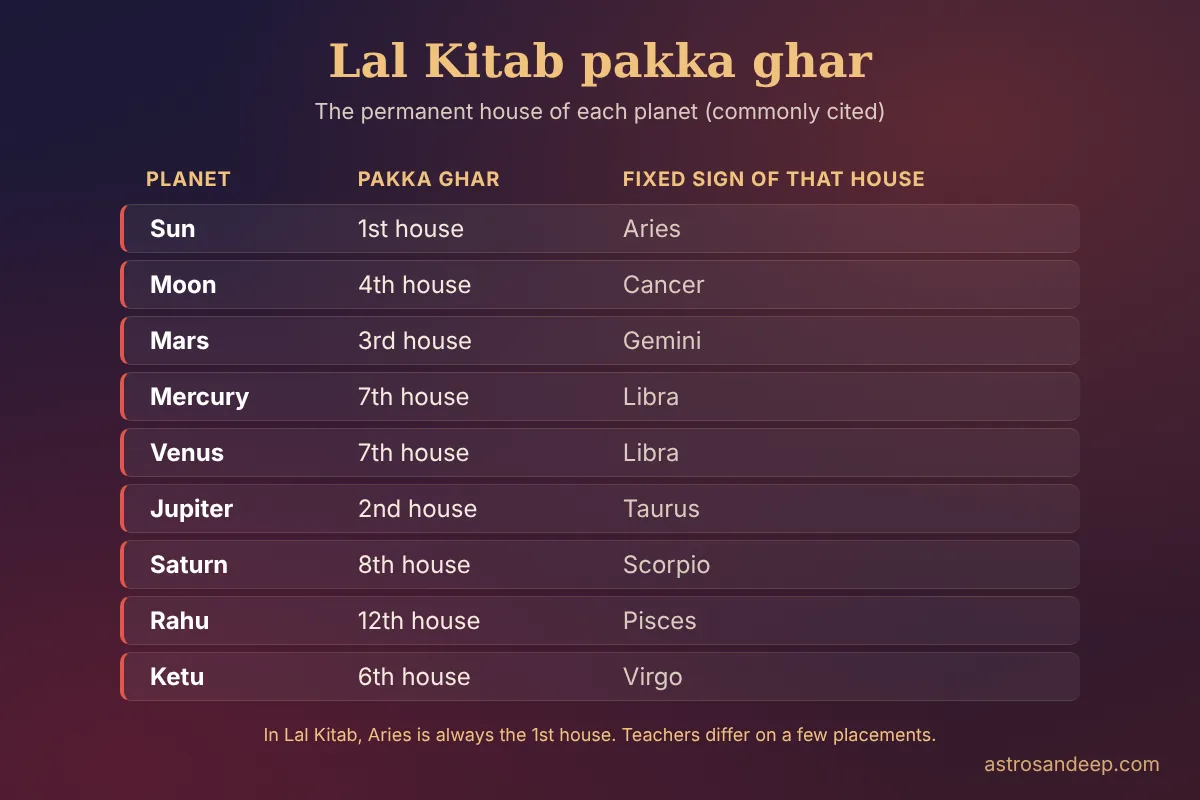
Many sites say you can apply Lal Kitab totke straight from your Vedic chart. I disagree. The house numbers are not the same in both systems, so a remedy meant for "Saturn in the 8th" in Lal Kitab may be aimed at the wrong planet if you read it off a Vedic lagna chart. You can generate your kundli here, but ask an astrologer to convert it before you start any upay.
The rules of Lal Kitab remedies
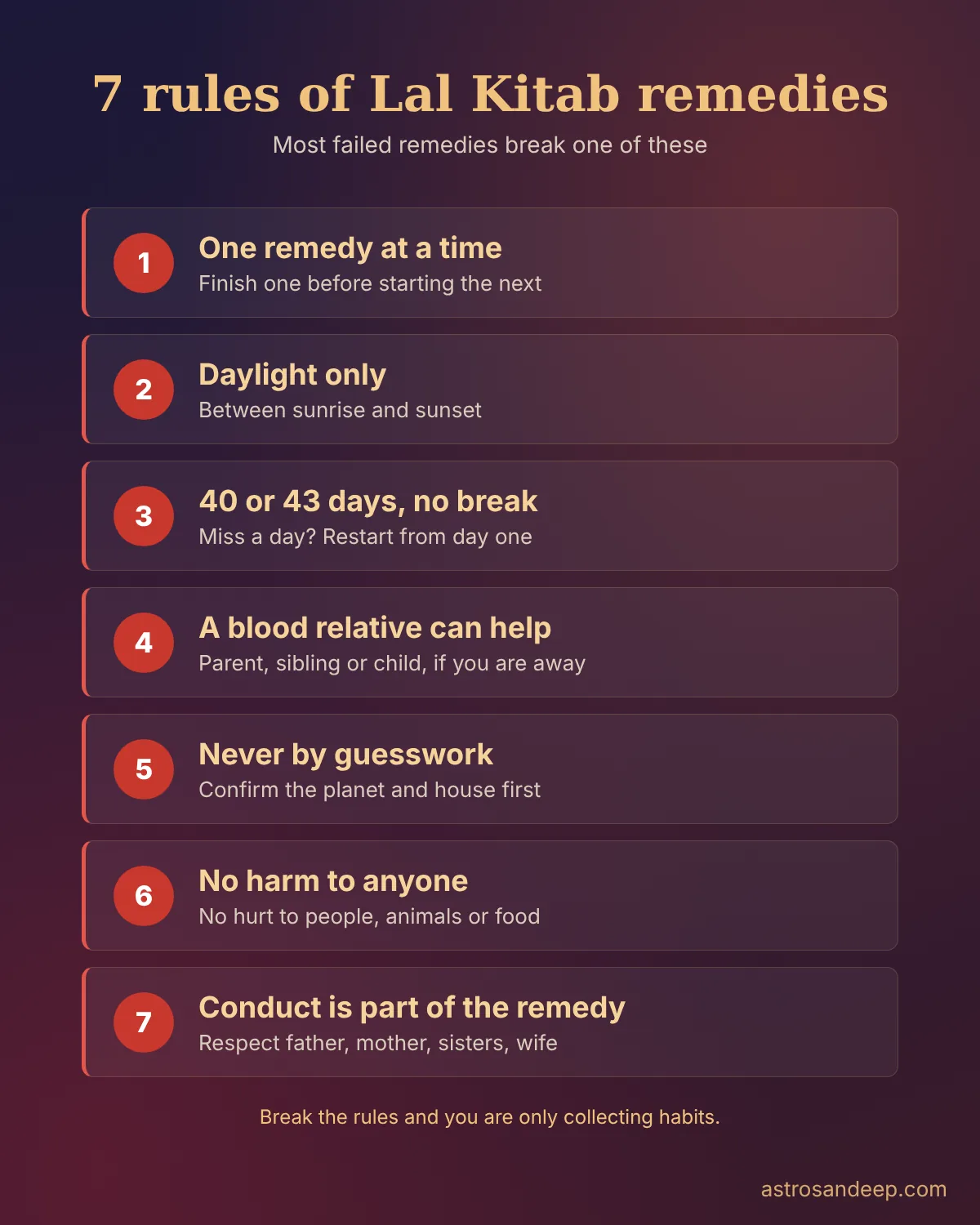
The rules of Lal Kitab remedies matter more than any single upay, and most failed remedies I see broke one of them. These are the rules as most Lal Kitab teachers apply them:
- One remedy at a time. Finish one before starting the next. Mixing three or four together confuses the effect and your own discipline.
- Daylight only. Remedies are done between sunrise and sunset unless the text says otherwise.
- 40 or 43 days without a break. If you miss a day, start the count again from day one.
- A blood relative can help. If you are travelling or unwell, a parent, sibling or child can perform it for you. Many NRI clients use this rule.
- Never by guesswork. The planet and house must be confirmed first. A remedy for a weak planet can disturb a planet that was already doing well.
- No harm to anyone. No remedy should hurt a person or an animal, or waste food in a disrespectful way.
- Conduct is part of the remedy. Lal Kitab ties planets to people: the Sun to the father, the Moon to the mother, Mercury to sisters and daughters, Venus to the wife. Respecting them is treated as the first upay.
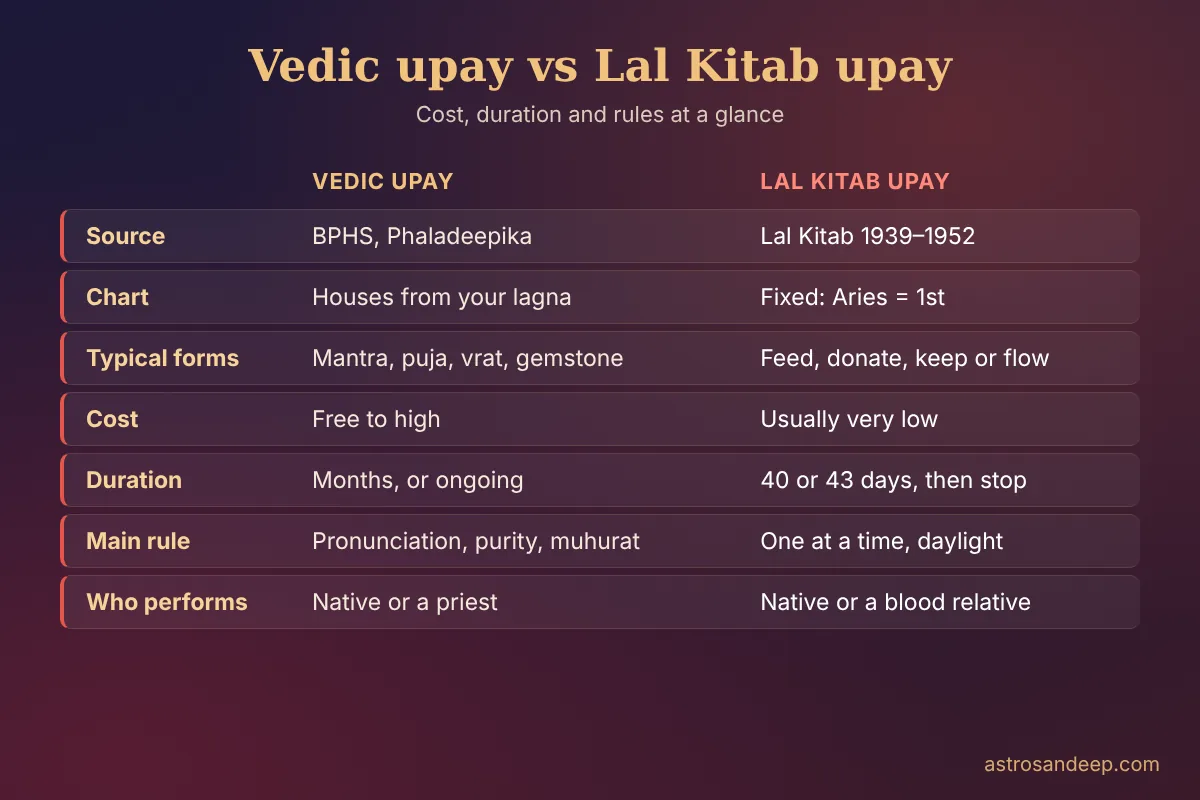
Vedic upay vs Lal Kitab upay: cost, duration and rules
Vedic remedies usually involve mantra, puja, fasting or gemstones over longer periods, while Lal Kitab remedies are cheap physical actions done for a fixed 40 or 43 days. Here is how I explain the difference to clients.
| Point | Vedic upay | Lal Kitab upay |
|---|---|---|
| Source | Brihat Parashara Hora Shastra, Phaladeepika and later texts | Lal Kitab, 1939–1952, with 1952 as the final text |
| Chart used | Houses counted from your lagna | Houses fixed: Aries = 1st house |
| Typical forms | Mantra jaap, puja, havan, vrat, gemstone, rudraksha | Feeding, donating, keeping or flowing an object, service to relatives |
| Cost | Ranges from free (mantra) to high (gemstones, large pujas) | Usually very low |
| Duration | Often months, or ongoing | Usually 40 or 43 days, then stop |
| Main rule | Correct pronunciation, purity, muhurat | One remedy at a time, daylight, no break |
| Who performs | Native or a priest on their behalf | Native, or a blood relative |
Neither system is "stronger". In my practice I use Vedic dasha and transit timing to see when a problem will ease, and Lal Kitab when a family needs something practical and affordable to do in the meantime. I keep the two separate when I write a remedy so the client knows which tradition it comes from.
Lal Kitab upay that are safe for most people to try
The safest Lal Kitab remedies are the ones based on service and conduct, because they help even when your chart does not call for them. I am labelling each one by system so you know where it comes from.
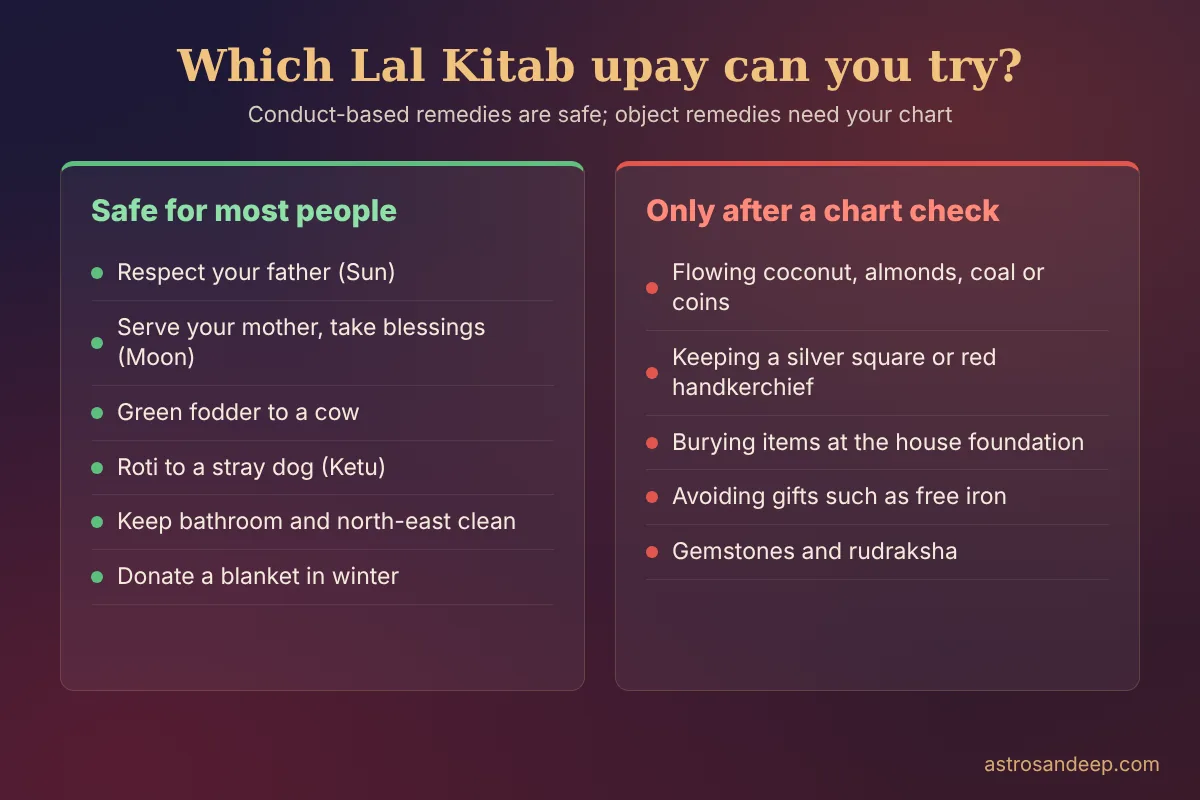
Lal Kitab, general (safe without a chart check):
- Respect your father and touch his feet in the morning. Lal Kitab ties the Sun to the father.
- Serve your mother, or an elderly woman in your family, and take her blessings before leaving home (Moon).
- Give green fodder to a cow on Wednesdays or as your family tradition allows.
- Feed a stray dog with a roti (Ketu). Do not force food it will not eat.
- Keep your bathroom and the north-east corner of the house clean and dry.
- Donate a blanket to someone who needs it in winter (Saturn and Ketu are linked with service to the poor).
Lal Kitab, only after a personal chart check:
- Flowing items such as coconuts, almonds, coal or copper coins in running water. If you are given this upay, I suggest offering the item at a temple where it will be used, rather than adding to a polluted river.
- Keeping a solid silver square, a piece of silver or a red handkerchief.
- Burying or not burying certain items at the house foundation.
- Avoiding gifts of particular items, such as not accepting free iron from others.
Vedic, safe for most people:
- Offering water to the Sun at sunrise with the Gayatri mantra or "Om Suryaya Namah".
- Chanting the mantra of your current mahadasha lord after you know it from your chart.
Gemstones, rudraksha and any remedy involving an object kept on the body are recommended only after a personal chart check. A wrong gemstone is the most common expensive mistake I see.
Not sure which planet needs attention? Book a Vedic chart reading with dasha and transit timing
Myths and facts about Lal Kitab remedies
Most fears about Lal Kitab remedies come from copied lists and half-translated verses, not from the text itself.
| Myth | Fact |
|---|---|
| Lal Kitab totke work overnight | Most remedies run 40 or 43 days, and results depend on your dasha and effort |
| You can do as many remedies as you like together | One at a time is the core rule |
| A remedy that worked for your cousin will work for you | Remedies are chosen for a planet in a specific house in your chart |
| Lal Kitab upay are meant to affect other people | Every remedy works on your own chart and conduct, never on another person |
| Lal Kitab replaces medicine or legal advice | It does not. See a doctor, lawyer or immigration consultant for those problems |
| Expensive remedies work better | Lal Kitab is known for cheap remedies. Cost is no measure of effect |
Manglik worries are a common example. Families panic about Mars, try five remedies at once and then blame the chart. I have written separately about how Manglik dosha is checked and when it cancels, including the Lal Kitab view of Mars.
An illustrative example: Saturn and a stalled promotion
This is an illustrative example, not a real client. Suppose a 34-year-old accounts officer in Panchkula has been passed over for promotion twice. In the Lal Kitab chart, Saturn sits in the 10th house and is not afflicted, but the 2nd house is asleep (no planet aspects it), and Jupiter is weak.
Following the general rules, I would not give a Saturn remedy at all, because Saturn in the 10th is doing reasonable work. I would first look at Jupiter, since in Lal Kitab Jupiter's pakka ghar is the 2nd house. A typical suggestion might be a simple Jupiter upay for 43 days, along with respecting teachers and elders at work. Alongside, I would check his Vedic dasha to see when the 10th house gets support in the timing.
What I would tell him honestly: the remedy does not write his appraisal. Clearing the pending exam, or speaking to his manager, matters as much as any upay. For job questions in more depth, my career and job astrology consultation covers the 10th house, dasha and transits together.
Limits of Lal Kitab remedies you should know
Lal Kitab remedies cannot override effort, and they depend on an accurate birth time. If your birth time is off by even 20 to 30 minutes, the lagna may shift in the Vedic chart, which changes the dasha reading I combine with Lal Kitab. For hospital births where the time was written down, this is rarely a problem. For home births or "around sunrise" entries, I spend part of the session checking past events against the chart before suggesting anything.
The second limit is translation. Lal Kitab remedies copied through three languages may have lost their condition. If one says "for Saturn" but not which house, skip it.
The third is health. Lal Kitab can point to periods when you should take better care of yourself. It cannot treat illness. Please see a doctor.
For marriage questions, Lal Kitab remedies are no substitute for proper matching. If a rishta is being considered, start with kundli milan and the 36 gunas and then look at remedies, not the other way round.
Lal Kitab consultation in Chandigarh, Mohali and for NRI families
Lal Kitab began in Jalandhar district, and Punjabi families looking for Lal Kitab remedies from Chandigarh, Mohali, Panchkula, Zirakpur and Kharar still ask for the system by name. I see clients in person at my office at Booth No. 50 (basement), Phase 1, Mohali, and many travel from Ludhiana, Patiala, Amritsar and Ambala. If you are searching for an astrologer in the Chandigarh tricity, that page explains how an in-person session works.
Online consultation works just as well. A large share of my Lal Kitab questions come from NRI families in Brampton, Surrey and Toronto, and from the USA, Australia and New Zealand. For births abroad, I convert the birth time from the local time zone (including daylight saving, where it applied) to the correct chart before reading it. Since Lal Kitab allows a blood relative to perform a remedy, a parent in Punjab can sometimes do the upay for a son or daughter in Canada. Details are on my page for astrology consultation for clients worldwide. Sessions are in Hindi, English or Punjabi.
Frequently asked questions
Do Lal Kitab remedies really work?
They can help when they are chosen correctly and followed by the rules. In my 21 years of practice, the remedies that seem to help are specific to one planet and house, done for the full 40 or 43 days, and combined with practical effort. They are traditional practices and acts of faith, and no astrologer can guarantee a result.
How many days should a Lal Kitab remedy be done?
Usually 40 or 43 days without a break. If you miss a day, most teachers ask you to restart the count. Some remedies are one-time actions and some are lifelong habits, such as respecting your father. Your astrologer should tell you the duration when the remedy is given.
Can I do two Lal Kitab remedies at the same time?
No, the standard rule is one remedy at a time. Finish one, then begin the next if needed. Doing many together is the most common mistake I see, and it makes it impossible to tell what is helping. It also makes the routine hard for a family to keep up.
Can someone else do a Lal Kitab remedy for me?
Yes, a blood relative can perform it on your behalf. This is useful when you are travelling, unwell or living abroad. A parent, brother, sister or child is usually accepted. A friend or a paid person is generally not, because Lal Kitab connects remedies to family lines.
Are Lal Kitab remedies safe to try from the internet?
Only the conduct-based ones are. Respecting parents, feeding animals kindly and donating to the needy are safe for almost everyone. Remedies involving keeping, burying or flowing objects should wait for a personal chart check, because the same upay can disturb a planet that is already well placed in your chart.
What is the difference between Lal Kitab remedies and Vedic remedies?
Lal Kitab remedies are cheap physical actions done for a fixed period, using a chart where Aries is always the 1st house. Vedic remedies include mantra, puja, fasting and gemstones, and count houses from your lagna. I often use Vedic dasha for timing and Lal Kitab for practical upay.
Can I get a Lal Kitab consultation online from Canada or the USA?
Yes, online sessions work the same as in-person ones. You share your date, time and place of birth, I convert the birth time correctly for your country, and we speak by call. The 30-minute session is booked online, and in-person sessions are at my Mohali office.
Before you start any Lal Kitab remedy
Lal Kitab remedies are most useful when they are few, specific and done with patience. Get the planet and house confirmed, pick one upay, follow the 40 or 43 day rule and keep doing your part. If you would like me to look at your chart and choose a remedy that fits it, you can book a consultation with Astro Sandeep. If you would rather message first, you can reach me on WhatsApp.
Disclaimer: Astrology, Lal Kitab, numerology and tarot offer guidance based on traditional principles. They are not a substitute for medical, legal, financial, immigration or psychological advice, and no astrologer can guarantee an outcome.